Andromeda is the first galaxy most people see, and the first object that teaches them how much of this hobby depends on patience. It is genuinely there: big, bright enough for inexpensive binoculars, and easy to find once you know the hop. Yet on a hazy night above a lit street it can refuse to appear at all, and plenty of people give up convinced they have done something wrong. The galaxy rewards a particular kind of preparation. A dark-adapted eye, a wide field, an accurate hop, and a willingness to look slightly away from the thing you are trying to see will do more for you than a bigger telescope.
When Andromeda Is Well Placed
From mid-northern latitudes the galaxy is available from late summer through early spring. October and November are the sweet spot: it crosses nearly overhead around 9 or 10 pm, and the higher an object sits, the less atmosphere and street glow you are looking through. In late August and September, look northeast once twilight is fully gone. By January it has begun to sink west, still fine early in the evening but lower and dimmer through more air.
Two timing rules matter as much as the calendar. The first is the Moon. Even a half Moon two handspans away will wash out the faint outer disk and leave you with nothing but a bright core, which is the least interesting part. Check the phase before you carry anything outside. The second is twilight. M31 is a low-surface-brightness object, and the difference between a sky twenty minutes after sunset and one ninety minutes after is enormous. Wait for full darkness, not just for the first star.
Prepare Your Eyes Before You Prepare the Telescope
Dark adaptation is not a poetic idea; it is a chemical process that takes roughly twenty to thirty minutes and can be undone in a second by a phone screen. Everything else in this article assumes you have done it.
- Turn off the porch light and any garden lighting before you start, not after you have found the galaxy.
- Put the phone face down in a pocket. A single glance at a bright screen resets most of your progress.
- Use a dim red light, and dim it further than feels comfortable. If you can read a chart, it is bright enough.
- Shield your eyes from the street. A dark cloth over the head works wonders for faint fuzzies, and it looks less strange than you fear.
- Learn your chart indoors, in white light, before you go out. Fumbling with a printout under a red lamp costs you the adaptation you just earned.
Give yourself the full twenty minutes with nothing bright in view. Then go straight to the eyepiece, or better, straight to the binoculars.
Star-Hopping to M31, One Star at a Time
Andromeda the constellation is a long, faint chain that is surprisingly hard to see as a shape from a suburb. Do not try to trace the whole princess. Anchor on Pegasus instead, then follow the chain of stars that runs out of it.
- Face east or northeast in early autumn, and find the Great Square of Pegasus: four stars of similar brightness around a large, almost empty patch of sky.
- Identify Alpheratz, the corner of the square nearest Andromeda. It is the brightest of the four and technically belongs to Andromeda, not Pegasus.
- Follow the chain northeast from Alpheratz: a fainter star, Delta Andromedae, then Beta Andromedae. That second one is Mirach, noticeably warmer in colour than its neighbours, and it is your key star.
- From Mirach, step northeast to Mu Andromedae, a fainter star that is easy in binoculars and just visible to the naked eye on a good night.
- Continue the same distance in the same direction to Nu Andromedae.
- Slide just past Nu, about a degree and a half further, and stop. The soft oval glow in your field is the galaxy.
If the chain gets confusing, there is a shortcut: Mirach to M31 is roughly eight degrees to the north-northwest. Put Mirach at the edge of a low-power binocular field, sweep slowly in that direction, and the core will drift in. The full step-by-step hop is still worth learning, because it lets you land on the galaxy directly rather than hunting for it.
What a Suburban Backyard Actually Shows You
Here is where expectations need adjusting. M31 has a respectable total magnitude, but it is spread across a patch of sky several times wider than the Moon. Surface brightness is what your eye cares about, and the suburbs steal exactly that.
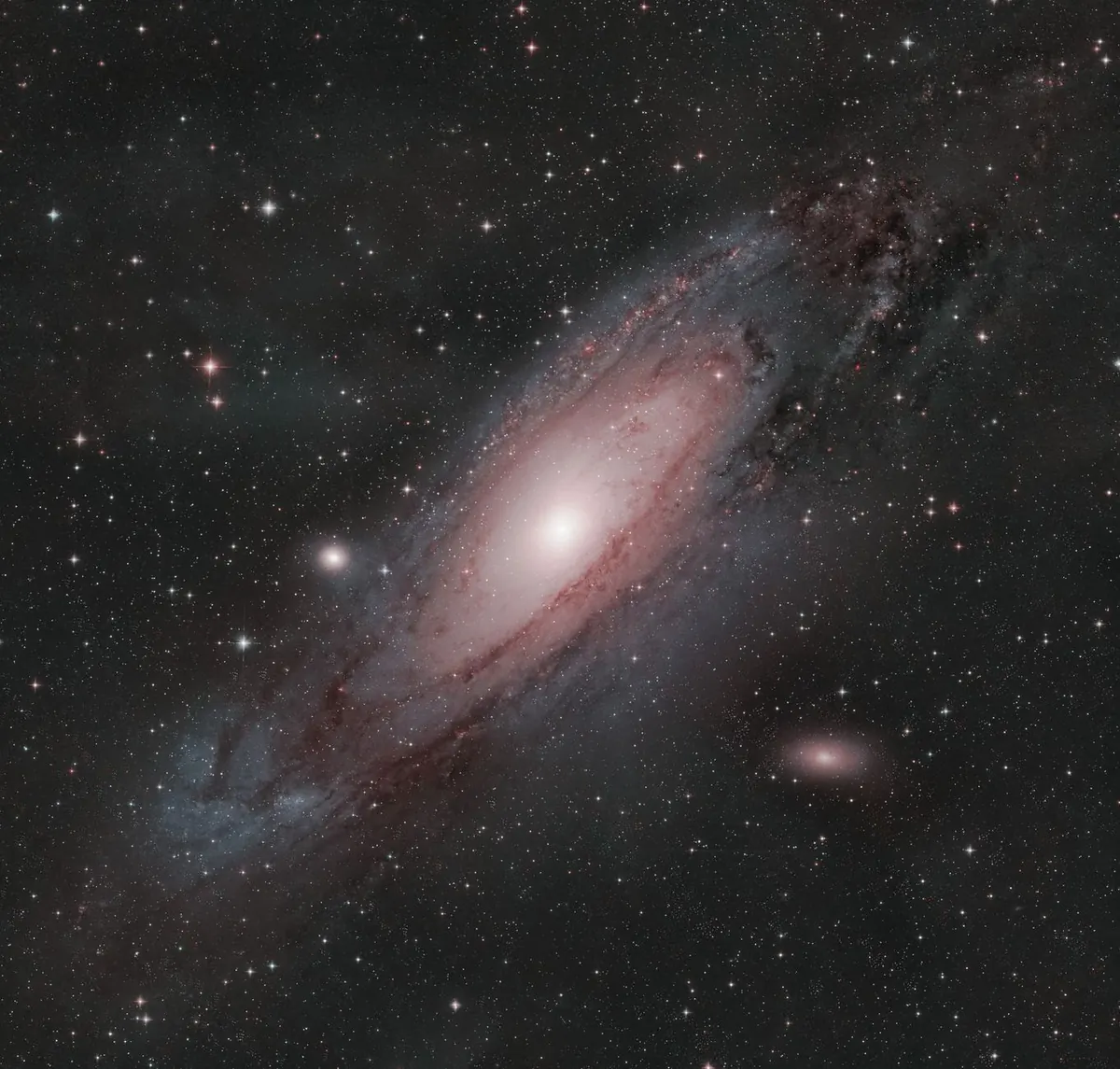
Naked eye, under typical suburban sky, you will see a small, faint smudge — often only with averted vision, looking slightly to the side of where you think the galaxy is. Binoculars transform it. The core becomes obvious, an elongated glow roughly the width of the full Moon, with the disk fading out from there. On a very good night the galaxy extends a couple of degrees, and nearby M32 appears as a small fuzzy point just off the core. M110, the second companion, is fainter and often lost in the glow. Neither companion looks like much, but finding them is a good sign that your sky and your eyes are cooperating.
The dust lanes that make photographs so striking — the dark band curling along the northern edge — are a dark-sky reward. In a suburb, most observers see, at best, a subtle unevenness in the glow after long study. That is not failure. It is an honest reading of the sky you have.
Gear, Magnification, and a Comfortable Neck
Binoculars around 7x50, 8x42 or 10x50 are close to ideal, and a reclining garden chair is not a luxury. Bracing your elbows on your chest while leaning back is the difference between a steady view and a wobbling one. If you have a tripod adapter, use it.
With a telescope, resist the urge to magnify. A magnification of roughly 25x to 40x with the widest eyepiece you own frames the galaxy properly; push to 100x and you will be looking at a crop of the core with no context. A dew shield doubles as a light shield, and a black cloth over your head cuts stray light from every direction at once. Keep both eyes open at the eyepiece — it is easier than squinting and keeps you relaxed.
Working With the Glow Around You
For diffuse objects, transparency — how clear and dry the air is — matters more than steady air. The best suburban nights often arrive after a cold front has scrubbed the haze away. Humid summer evenings with a milky sky will beat you no matter what you are using.
Notice where the worst light comes from and put your back to it. Even moving a few metres to the shadowed side of a house can help. Try gauging the night by counting the stars you can see inside the Great Square of Pegasus; a mental record of that number across the season tells you more about your conditions than any forecast. And it is worth asking a neighbour to switch off a decorative light for an hour — most people say yes.
A Practical Checklist for Your First Attempt
- Check the Moon phase and wait until it is down or thin.
- Print or download a chart showing the Alpheratz–Mirach–Mu–Nu line, and study it in white light.
- Set up in the darkest corner of the garden, back to the street.
- Let your eyes adapt for twenty minutes with no white light, phone included.
- Start at Mirach, run the hop, and land past Nu Andromedae.
- Use averted vision and give the galaxy a full five minutes; it usually improves.
- Try low power first, then a little more, and note which your sky prefers.
Do this two or three times across a season and the hop becomes automatic — Mirach, Mu, Nu, and there it is. From then on, Andromeda stops being a target and becomes a habit, one you can check on any clear autumn evening without a chart, a battery or a plan.
Photo: Marco Milanesi / Pexels